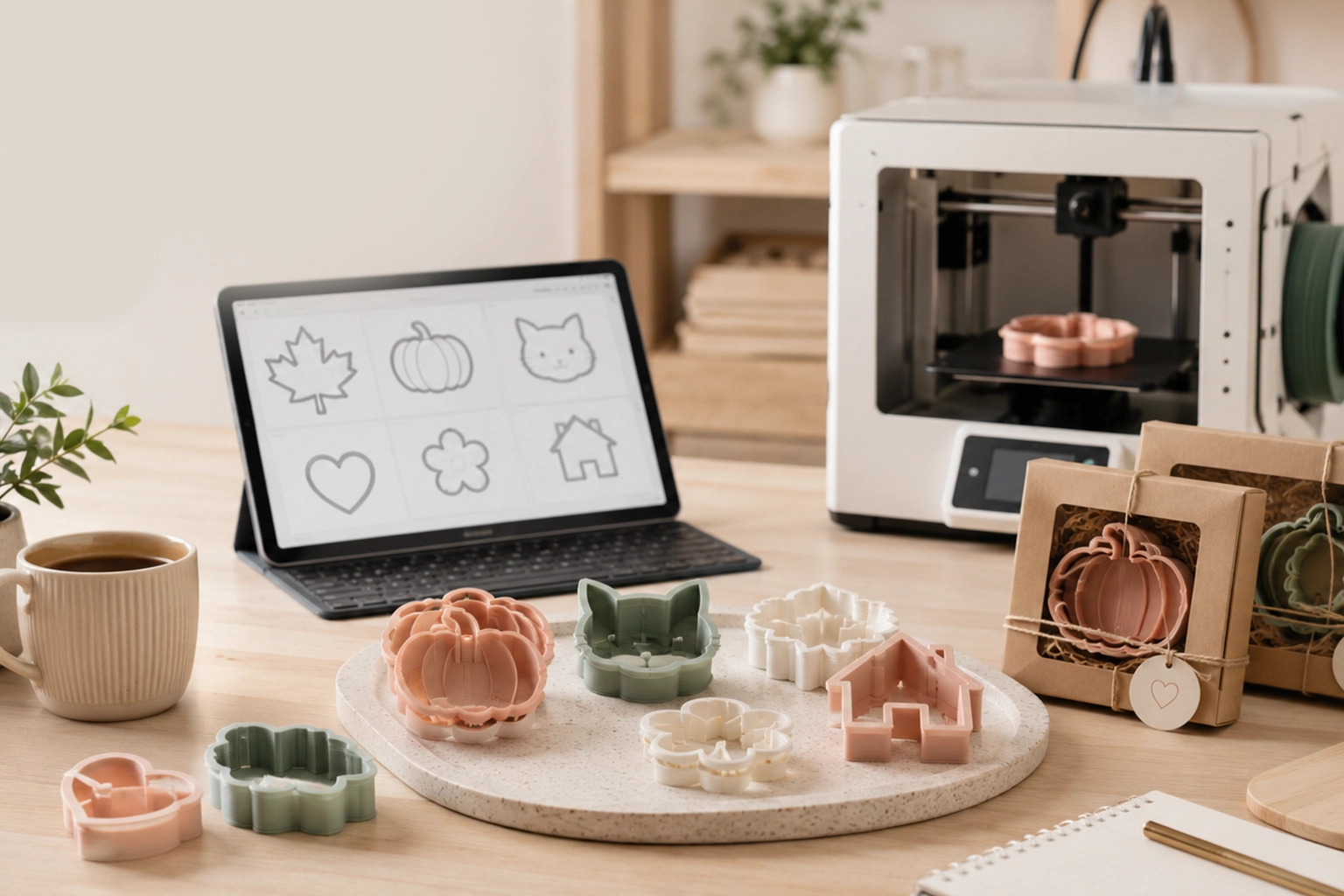

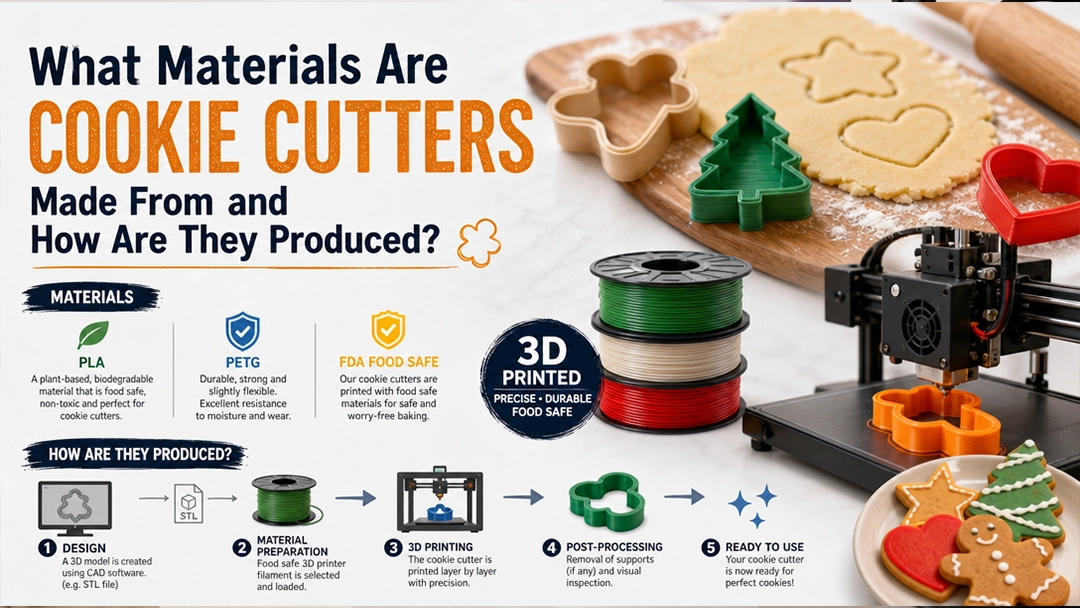
Cookie cutters may look simple, but the material behind them affects almost everything: edge sharpness, durability, food-contact use, cleaning, comfort, design detail, and how easily a custom shape can be made. Traditional cookie cutters are often made from metal or molded plastic, while many modern custom cutters are produced with 3D printing using materials such as PLA filament.
If you are choosing cookie cutters for baking, building a handmade product line, selling seasonal cutters, or turning your own artwork into a printable design, it helps to understand how different materials behave. A stainless steel cutter, an injection-molded plastic cutter, and a 3D printed PLA cutter can all cut dough, but they are produced in very different ways and are better suited to different use cases.
This guide explains what materials cookie cutters are made from, how they are produced, and why a clean STL file is often the starting point for custom cookie cutter production.
What Materials Are Cookie Cutters Usually Made From?
Cookie cutters are commonly made from metal, molded plastic, or 3D printed plastic. Each material has its own strengths. The right choice depends on whether the cutter is being used at home, sold as a product, made for a bakery, or created as a custom shape from artwork or a 3D model.
Metal cookie cutters are usually chosen for durability and thin cutting edges. Plastic cookie cutters are common for colorful, affordable, lightweight designs. 3D printed cookie cutters are popular for custom shapes, small-batch production, personalized sets, and designs that would be expensive to manufacture with traditional tooling.
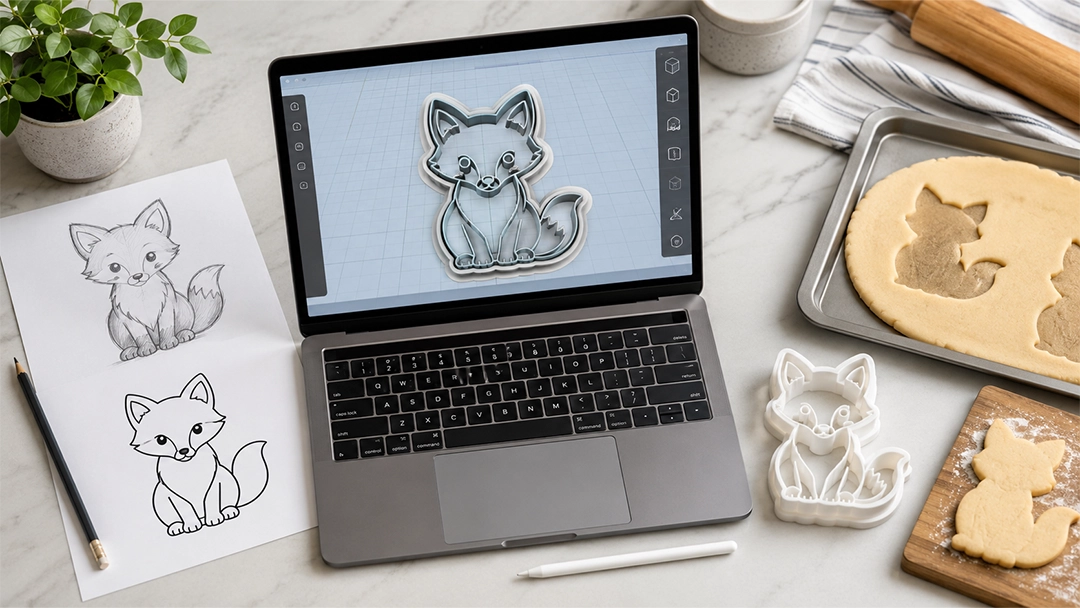
For makers and small businesses, the biggest shift is that cookie cutter production no longer has to begin with a factory mold. A custom design can start as a drawing, logo, reference image, or SVG-style outline, then become a digital model and printable STL file. With a cookie cutter STL builder, that design can be prepared for 3D printing without relying on mass-production tooling from the beginning.
Metal Cookie Cutters: Stainless Steel, Tinplate, Copper, and Aluminum
Metal is one of the oldest and most familiar materials for cookie cutters. Metal cutters are often made from thin strips that are shaped into an outline, joined at the seam, and finished to create a usable cutting edge. This approach works especially well for classic shapes such as hearts, stars, circles, trees, animals, flowers, and holiday designs.
Stainless steel is popular because it is strong, clean-looking, and resistant to corrosion when cared for properly. Tinplate has also been used for traditional cutters, although it may require more careful drying and storage. Copper cutters are often valued for their appearance and gift-quality feel, while aluminum cutters are lightweight and easy to shape.
Metal cutters are usually a good fit when you want a thin edge, a long-lasting tool, and a shape that can be bent from a continuous strip. However, metal is less flexible when it comes to highly detailed, layered, or personalized shapes. Complex lettering, internal embossing, raised handles, and intricate custom geometry can be harder or more expensive to produce with traditional metal-forming methods.
Plastic Cookie Cutters: Molded Designs for Everyday Use
Plastic cookie cutters are often made through injection molding, where heated plastic is pushed into a mold cavity and cooled into the final shape. This method is efficient for large production runs because once the manufacturing mold exists, the same design can be repeated many times.
Molded plastic cutters can include comfortable handles, thick walls, bright colors, and child-friendly shapes. They are common in retail baking sets because they are lightweight and easy to package. Some molded cutters also include stamp details, embossing surfaces, or press-style features for decorating dough.
The main limitation is the cost and setup time of the mold used to manufacture the plastic cutter itself. If you only need a small batch, a seasonal design, a custom logo, or a personalized cookie cutter, injection molding may be more than the project needs. This is where 3D printed cookie cutters can be a better fit because they allow the design to be produced directly from a digital file.
PLA Filament and 3D Printed Cookie Cutters
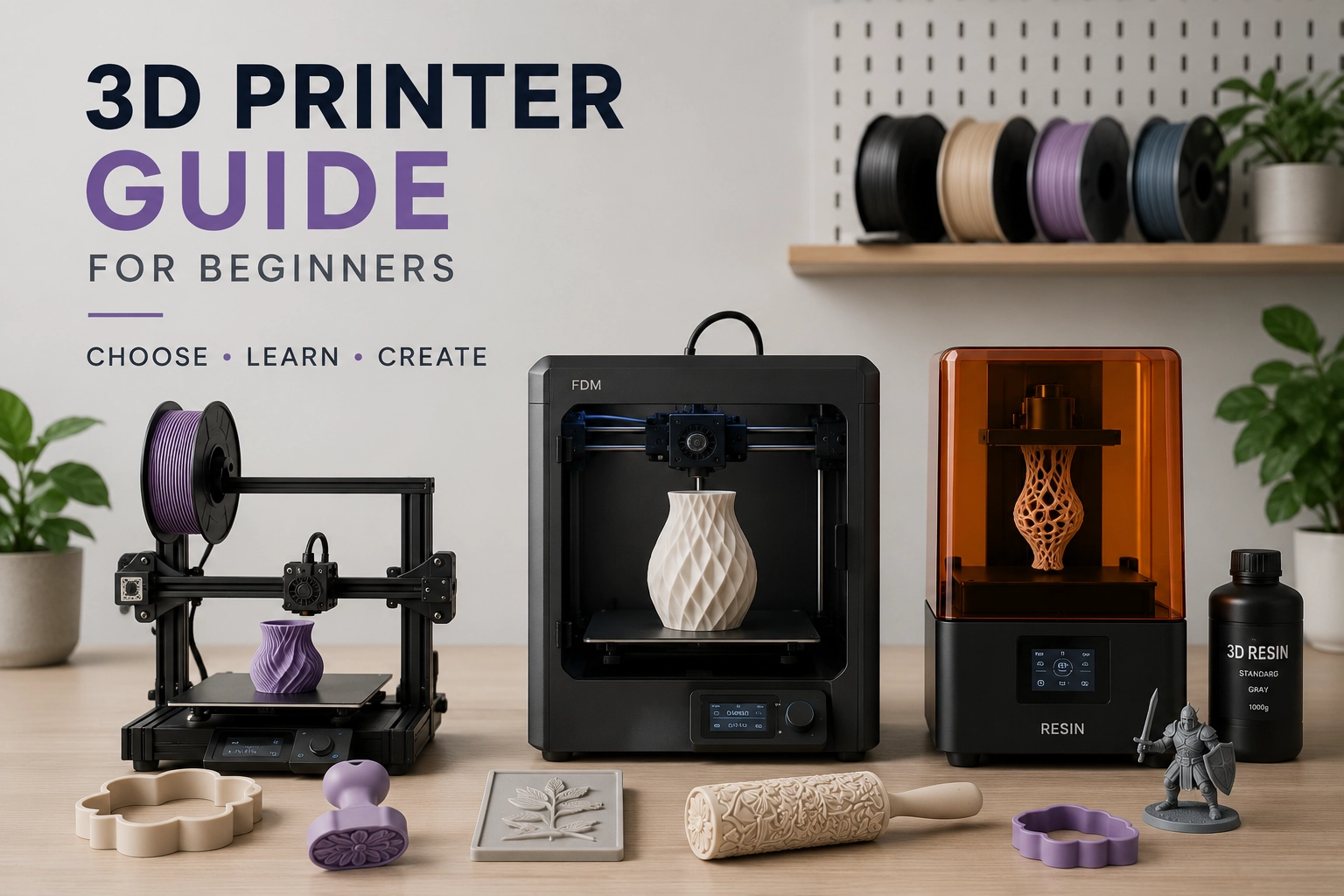
PLA filament is one of the most common materials used for 3D printed cookie cutters. PLA is popular because it is widely available, relatively easy to print, and capable of holding crisp shapes when the model is prepared correctly. For custom cutters, PLA is often used with FDM 3D printers, which build the cutter layer by layer from a digital STL file.
For many small shops, PLA filament makes custom cookie cutter production more accessible. Instead of ordering a large production run, a maker can design one cutter, test it, adjust the wall thickness or cutting edge, and print another version. This is useful for Etsy sellers, home bakeries, seasonal collections, personalized gifts, party themes, and limited-edition cookie decorating sets.
That said, PLA is not a magic shortcut. A 3D printed cutter is only as good as the model and print settings behind it. The wall needs to be strong enough, the cutting edge needs to be thin enough to work, and the handle or rim should be comfortable to press. If the design is too fragile, too shallow, or poorly scaled, the cutter may not perform well even if the filament itself prints cleanly.
Food-contact use also requires care. Not every filament, printer setup, nozzle, surface, or post-processing method is intended for food use. Layer lines can also create small grooves, so cleaning and material selection matter. If a 3D printed cutter will touch dough, always follow the filament manufacturer’s guidance and use materials, printer components, and cleaning practices appropriate for food-contact applications.
How Are 3D Printed Cookie Cutters Produced?
3D printed cookie cutters are produced from a digital model, usually exported as an STL file. The STL file describes the cutter’s shape so slicing software can convert it into printer instructions. The printer then builds the cutter one layer at a time using filament such as PLA.
The process usually looks like this:
- Start with the idea. The design may begin as a sketch, logo, reference image, simple outline, SVG file, or existing 3D model.
- Create the cutter geometry. The outline is converted into a usable cutter shape with wall thickness, cutting height, rim height, and support features.
- Check the cutting edge. The edge should be thin enough to cut dough but not so fragile that it breaks during printing or use.
- Add a handle or comfort rim. Many 3D printed cutters include a thicker top edge to make pressing easier.
- Export the STL file. The model is exported as a printable STL file for mold-free digital production.
- Slice and print. The STL is prepared in slicing software, then printed with the chosen filament and settings.
- Test and adjust. The first print may reveal small improvements in size, edge depth, or strength.
This digital workflow is why custom cookie cutter production works so well for small-batch makers. You can create a design, print it, test it with dough, adjust the file, and build a repeatable product without committing to expensive manufacturing molds. If you already have artwork or a reference image, you can create custom cookie cutter STL files before printing the final design.
Comparing Cookie Cutter Materials
No single material is right for every cookie cutter. A bakery using the same circle cutter every day may prioritize durability and a thin metal edge. A small handmade seller creating themed holiday sets may prioritize custom shapes and fast design changes. A hobby baker may simply want a fun cutter that is easy to use and store.
Material Common Production Method Best For Considerations Stainless steel Cut and formed metal strip Durable classic shapes and repeated use Less flexible for complex custom detail Tinplate Formed metal strip Traditional cookie cutter styles Needs careful drying and storage Copper Hand-formed or specialty metal production Decorative, gift-quality, or premium cutters Usually higher cost and more niche Molded plastic Injection molding Large production runs and colorful retail sets Requires manufacturing tooling before production PLA filament FDM 3D printing Custom cookie cutters, small batches, personalized designs Requires a clean STL file, suitable print settings, and food-contact careFor custom work, PLA filament and 3D printing offer a practical advantage: the design can be changed quickly. If the cutter needs to be taller, wider, sharper, simpler, or easier to press, the STL file can be adjusted before the next print. That flexibility is especially useful for small shops testing new product ideas.
What Makes a Good Cookie Cutter STL File?
A cookie cutter STL file is not just a flat outline. A good file is built around how the cutter will actually be printed and used. It should have enough height to cut through dough, enough wall thickness to survive handling, and a clean cutting edge that does not crush the shape.
Important design details include:
- Cutting edge thickness: The lower edge should be fine enough to cut cleanly but strong enough to print reliably.
- Wall thickness: Thin walls may break or flex too much, while overly thick walls can make the cutter bulky.
- Top rim or handle: A thicker upper rim makes the cutter more comfortable to press into dough.
- Design simplicity: Very tiny details may not cut well, especially in sticky or soft dough.
- Correct scale: The cutter should match the intended cookie size, packaging, and decorating style.
- Clean mesh geometry: A watertight, print-ready STL helps avoid slicing and printing issues.
This is where the design file matters more than many beginners expect. A cutter can look attractive on screen but still be uncomfortable, fragile, or hard to clean if the geometry is not prepared for real use. Before printing a batch, it is worth using an online STL editor to review the shape, adjust the design, and export a cleaner file.
Ready-Made Cookie Cutters vs Custom 3D Printed Cutters
Ready-made cookie cutters are a good choice when you need a common shape quickly. Hearts, circles, stars, gingerbread people, flowers, pumpkins, and holiday trees are easy to find in metal or plastic. If the shape is standard and the size works, there may be no reason to create a custom file.
Custom 3D printed cookie cutters make more sense when the design needs to be personal, branded, seasonal, or specific. For example, a small bakery may want a cookie cutter based on its logo. An Etsy seller may want a collection of themed cutters with matching sizes. A party planner may need names, numbers, animals, or character-inspired silhouettes. A maker may want to test five variations before choosing the final product.
The main benefit of custom STL design is control. You can decide the size, height, border thickness, edge style, and whether the cutter needs embossing or a matching stamp. If your project starts with artwork rather than a finished 3D file, an AI STL generator can help turn a reference image or simple concept into printable geometry that can be refined for cookie cutter use.
For sellers, this control can support product discovery and collection planning. Instead of selling one random cutter, you can build coordinated sets: birthday numbers, pet shapes, wedding themes, seasonal bundles, bakery logo cutters, or matching cutter-and-stamp designs. A custom STL workflow makes it easier to test those ideas before investing in inventory.
How to Choose the Right Cookie Cutter Material
The best material depends on how the cutter will be used. Start with the purpose, then choose the material and production method around that purpose.
Choose metal cookie cutters if you want a traditional tool, a thin cutting edge, and a durable shape for repeated use. Metal is especially useful for simple outlines and classic cookie shapes.
Choose molded plastic cookie cutters if you are buying a ready-made set, need colorful designs, or want lightweight cutters for casual home use. Molded plastic can also work well for children’s baking kits and retail bundles.
Choose PLA filament and 3D printed cookie cutters if you need custom shapes, small batches, personalization, fast product testing, or a design made from your own artwork. This route is especially useful when you want to move from concept to physical cutter without traditional manufacturing tooling.
For small business owners, the decision often comes down to flexibility. If you are making a common shape, ready-made may be enough. If you are creating a signature product, a custom theme, or a cutter that supports your brand, a print-ready cookie cutter STL gives you more control over the final result.
Common Mistakes in Cookie Cutter Production
Most cookie cutter problems come from small design decisions that are easy to overlook before printing or manufacturing. A cutter may technically print, but that does not mean it will cut dough well, feel good in the hand, or hold up during repeated use.
- The edge is too thick: A blunt edge may press the dough instead of cutting it cleanly.
- The wall is too thin: A fragile cutter can bend, crack, or break during use.
- The design is too detailed: Tiny points, narrow gaps, and small internal shapes may not release cleanly from dough.
- The cutter is too shallow: It may not cut through rolled dough evenly.
- The file is not print-ready: Mesh errors, open geometry, or wrong scale can cause failed prints.
- The material choice is unclear: A cutter intended for food-contact use needs appropriate material and handling decisions.
These issues are much easier to fix digitally than after a batch has been printed. If you are preparing a cutter for a shop, bakery, or product launch, test the STL first, check the size, and make sure the design supports how real dough behaves. You can also create cookie cutter designs from artwork, adjust them digitally, and export files that are easier to test before production.
Final Thoughts: Better Cookie Cutters Start with Better Files
Cookie cutters can be made from stainless steel, tinplate, copper, aluminum, molded plastic, or 3D printed materials such as PLA filament. Each material has a place. Metal is strong and traditional. Molded plastic is lightweight and common in retail sets. PLA filament is especially useful for custom cookie cutters, small-batch production, personalized shapes, and fast design testing.
For custom work, the most important step is not choosing the filament first. It is preparing the right STL file. The file controls the cutter’s outline, wall thickness, cutting edge, comfort rim, scale, and overall usability. A weak design can waste print time and material, while a clean digital model gives you a better starting point for testing and production.
If you already have an idea, sketch, object, logo, or reference image, the next step is turning it into a printable cookie cutter file. Before you print a batch or buy materials, make sure the design starts with a clean STL that is built for real cookie cutter use.
Key Takeaways
- Cookie cutters are commonly made from metal, molded plastic, or 3D printed plastic such as PLA filament.
- Metal cutters are durable and traditional, but they are less flexible for complex custom shapes.
- Molded plastic works well for large production runs, but it usually requires manufacturing tooling.
- PLA filament is popular for custom 3D printed cookie cutters because it supports small-batch testing and personalized designs.
- A good cookie cutter STL file needs proper wall thickness, a usable cutting edge, correct scale, and clean geometry.
- For custom cookie cutters, the quality of the finished tool depends heavily on the quality of the digital model behind it.
FAQ
What materials are cookie cutters made from?
Cookie cutters are commonly made from stainless steel, tinplate, copper, aluminum, molded plastic, or 3D printed plastic such as PLA filament. The best material depends on the cutter’s shape, intended use, durability needs, and whether it is custom or ready-made.
Is PLA filament used for cookie cutters?
Yes, PLA filament is commonly used for 3D printed cookie cutters because it prints cleanly and works well for custom shapes. For food-contact use, material choice, printer setup, cleaning, and filament manufacturer guidance should all be considered carefully.
How are metal cookie cutters produced?
Metal cookie cutters are usually made by shaping thin metal strips into an outline, joining the seam, and finishing the edge. This method works well for classic shapes but can be less practical for highly detailed custom designs.
How are 3D printed cookie cutters produced?
3D printed cookie cutters are produced from a digital STL file. The file is sliced into printer instructions, then printed layer by layer using filament such as PLA. The quality of the cutter depends on both the STL design and the print settings.
Do I need a custom STL file to make cookie cutters?
You do not always need a custom STL file. Ready-made cutters work well for common shapes. A custom STL file is better when you need a specific size, logo, theme, personalized shape, matching set, or product design for small-batch production.
If you have artwork, a logo, a sketch, or a reference image, you can turn it into a custom cookie cutter STL before printing. CreateMold helps makers move from idea to printable file, so you can test shapes, adjust details, and prepare cookie cutters for small-batch production with fewer design surprises.