
When people start making silicone molds, they usually focus on the object they want to duplicate, the type of silicone they should buy, or the casting material they plan to pour later. But one of the most important choices often gets overlooked: Shore hardness.
Shore hardness tells you how soft or firm a silicone rubber will feel after it cures. In mold making, this affects how easily the finished casting releases, how much detail the mold can hold, how stable the mold shape stays, and whether the mold walls flex too much during use. A very soft 5A silicone behaves differently from a firmer 30A or 40A silicone, even if both are used for the same object.
Choosing the right Shore hardness is not only about the silicone itself. It also depends on the shape of your master object, the wall thickness around it, and the mold box that holds the silicone during pouring. A well-planned mold box can support the silicone, reduce waste, and help you create a cleaner mold from the beginning.
What Is Shore Hardness in Silicone Mold Making?
Shore hardness is a way to describe how soft or firm a rubber-like material is. In silicone mold making, you will often see ratings such as Shore A 5, Shore A 10, Shore A 20, Shore A 30, or Shore A 40. Lower numbers mean the cured silicone is softer and more flexible. Higher numbers mean the silicone is firmer and more resistant to bending.
For mold makers, Shore hardness matters because the silicone must do two jobs at the same time. It needs to capture the surface detail of the master object, and it needs to release the finished casting without tearing, stretching too much, or distorting the shape. The right hardness helps balance those needs.
A very soft silicone can bend around undercuts and delicate shapes, which can make demolding easier. But if the silicone is too soft for the mold size, it may sag, deform, or lose dimensional stability. A firmer silicone can hold its shape better, but it may be less forgiving when the object has deep undercuts, sharp details, or areas that lock into the mold.
This is why Shore hardness should be chosen together with the mold design, not separately. The silicone, the master object, the wall thickness, and the mold box all work as one system.
Why Shore Hardness Changes the Way a Silicone Mold Works
Two molds can look almost identical and behave very differently if they are made with different Shore hardness levels. A soft mold may peel away easily from a resin charm or detailed figurine. A firmer mold may keep a flat soap bar, candle mold, or product prototype more stable during repeated use.
The main differences usually show up in four areas:
- Flexibility: Softer silicone bends more easily, which helps with delicate parts and undercuts.
- Support: Firmer silicone holds shape better, especially in larger molds or flat-sided designs.
- Detail release: Softer silicone can release complex details more gently, but may distort if too thin.
- Durability: Firmer silicone may resist deformation better, but the right choice still depends on the object and casting material.
For example, a small resin pendant with raised details may work better with a softer silicone because the mold needs to flex during release. A rectangular soap mold or candle mold may benefit from a firmer silicone because the walls need to stay straighter. A prototype mold may need a balance between detail capture and dimensional accuracy.
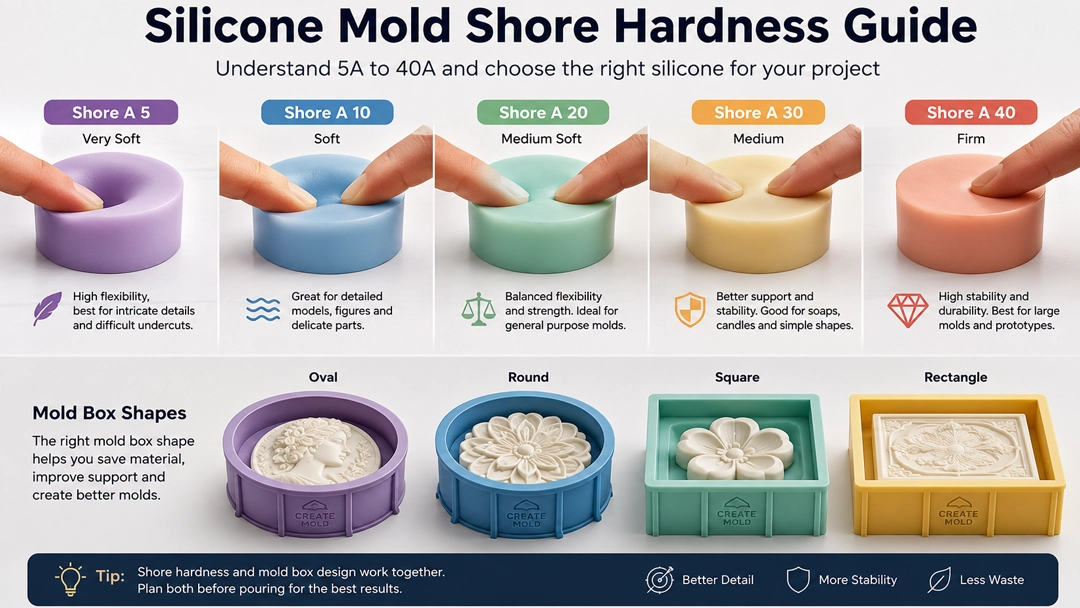
The mold box also affects this behavior. If the silicone has enough support around the master, even a softer Shore can perform more predictably. If the mold box is too large, too thin, or poorly shaped, the silicone may waste material or flex more than expected. Before pouring, it is worth planning the outer mold form with a tool like CreateMold Mold Box, where makers can design oval, round, square, and rectangular mold boxes around their silicone mold project.
Shore 5A, 10A, 20A, 30A, and 40A Compared
There is no single Shore hardness that works for every silicone mold. The best option depends on what you are casting, how much flexibility you need, and how stable the mold needs to remain during use.
Shore Hardness General Feel Best For Watch For Shore A 5 Very soft and highly flexible Delicate details, deep undercuts, fragile shapes, complex demolding Can distort easily if the mold walls are too thin or unsupported Shore A 10 Soft and flexible Small resin molds, detailed objects, figurines, flexible release needs May need a well-fitted mold box to prevent sagging or excess movement Shore A 20 Soft-medium flexibility General mold making, charms, small objects, soap, wax, resin, craft molds Still needs proper wall thickness and object spacing Shore A 30 Medium firmness Soap molds, candle molds, simple product forms, flatter shapes Less forgiving for strong undercuts or locked-in shapes Shore A 40 Firm and more shape-stable Larger molds, simple geometry, prototypes, flat-sided casting forms Can make demolding harder if the object has deep recesses or delicate detailsThink of Shore hardness as a design choice, not just a material label. A 10A silicone may be excellent for a small, detailed figurine, but too flexible for a large rectangular mold with thin walls. A 40A silicone may be useful for a stable block mold, but frustrating if the original object has narrow overhangs that need the mold to stretch during release.
When to Use Softer Silicone: Shore A 5 and Shore A 10
Shore A 5 and Shore A 10 silicones are very flexible. They are often used when the casting shape is delicate, detailed, or difficult to remove from a rigid mold. The lower hardness allows the silicone to bend around raised areas, small recesses, and mild undercuts without putting too much pressure on the finished piece.
Softer silicone can be useful for:
- small resin charms with raised details;
- miniatures and figurines;
- objects with fragile edges;
- decorative pieces with undercuts;
- molds that need to peel away gently from the casting;
- one-piece molds where flexibility helps with release.
The tradeoff is support. Very soft silicone can stretch, bend, or deform if the mold is too large or too thin. That is why the mold box becomes especially important. A tight, well-shaped mold box can help keep the silicone thickness consistent and reduce unnecessary movement.
If you are working with a small object, you may not need a large rectangular block around it. A round or oval mold box may reduce excess silicone and create a more efficient shape around the master. With a custom mold box for silicone casting, you can plan the outer form before pouring and choose a shape that fits the object more closely.
When to Use Medium Silicone: Shore A 20 and Shore A 30
Shore A 20 and Shore A 30 are common choices for many general silicone mold making projects because they offer a practical balance between flexibility and stability. They are soft enough for many craft applications but firm enough to hold their shape better than very low Shore silicones.
Shore A 20 is often a flexible middle ground. It can work well for resin molds, small craft molds, wax pieces, decorative shapes, and objects that need some bending during release. It is usually easier to handle than very soft silicone while still offering useful flexibility.
Shore A 30 feels noticeably firmer. It can be a good choice for simpler shapes, soap molds, candle molds, and projects where the mold needs to hold straighter walls. If the master object has only mild details and does not require aggressive flexing during demolding, 30A can provide a more stable result.
For small handmade businesses, these mid-range hardness levels are often practical because they can support repeatable production. A soap maker may need a mold that stays square. A candle maker may need a mold that does not bulge. A resin artist may want enough flexibility for release without the mold collapsing during use.
This is where mold box shape matters. A square or rectangular mold box can help create straight sides for soap, wax, or product forms. A round or oval mold box can work better around circular objects, medallions, coasters, ornaments, or decorative pieces. You can design oval, round, square, or rectangular mold boxes depending on the shape and support your silicone mold needs.
When to Use Firmer Silicone: Shore A 40
Shore A 40 silicone is firmer and more shape-stable than lower Shore options. It can be useful when the mold needs to resist flexing, hold a cleaner block shape, or support a larger casting area. This can matter for simple product prototypes, larger flat molds, basic geometric forms, and designs where dimensional stability is more important than extreme flexibility.
Firmer silicone may be useful for:
- simple shapes with minimal undercuts;
- larger molds that need better support;
- flat-sided soap or wax forms;
- prototype molds where size consistency matters;
- objects that release straight out of the mold;
- casting projects where the mold should not flex much during filling.
The risk with 40A silicone is demolding difficulty. If the object has deep undercuts, sharp internal details, or fragile protrusions, the mold may not flex enough to release the piece comfortably. In those cases, the mold may need to be split into multiple parts, or a softer silicone may be more suitable.
Firmer silicone also benefits from good planning. If you are using a firmer material, the mold box should give you enough wall thickness without creating unnecessary bulk. A too-large box can waste silicone. A too-tight box can make the mold weak around the edges. Planning the box before mixing silicone helps avoid both problems.
How Mold Box Design Affects Silicone Shore Choice
Shore hardness tells you how the cured silicone behaves, but the mold box controls the space where that silicone cures. This is why mold box design matters more than many beginners expect.
A mold box affects:
- Silicone thickness: The distance between the master object and the mold box walls determines how much silicone surrounds the part.
- Material usage: A box that is much larger than needed can waste silicone.
- Shape support: The mold box helps the silicone cure into a stable outer form.
- Demolding workflow: The outer shape can make the mold easier or harder to handle.
- Repeatability: A clean, planned mold box helps create more consistent silicone molds.
For example, a round object inside a large square box may use more silicone than necessary. A slim rectangular object may need a rectangular mold box to keep the walls efficient and even. A medallion, ornament, coaster, or circular design may make more sense in a round mold box. Organic shapes can sometimes fit better in an oval form.
This is exactly where Mold Box by CreateMold fits naturally into the mold making workflow. Instead of guessing the outer container shape by hand, makers can design the silicone mold box digitally in oval, round, square, or rectangular formats. That makes it easier to plan the mold before silicone is mixed, especially when you are trying to control wall thickness, casting space, and material use.
Shore hardness controls how the silicone feels. Mold box design controls how that silicone is supported.
How to Choose the Right Shore Hardness for Your Silicone Mold
The easiest way to choose Shore hardness is to start with the object, not the silicone. Look at the master shape and ask how the finished casting will come out of the mold. If the object has lots of detail, deep undercuts, or fragile protrusions, you may need softer silicone. If the object is simple, flat, or geometric, a medium or firmer silicone may be more useful.
Use this simple framework:
- Check the shape complexity. More undercuts and delicate details usually need more flexibility.
- Decide how much support the mold needs. Larger molds and flat-sided products often need firmer silicone or better mold box support.
- Think about the casting material. Resin, wax, soap, chocolate, plaster, and other materials behave differently during pouring and release.
- Plan the wall thickness. Thin silicone walls can deform, especially with lower Shore hardness levels.
- Choose the mold box shape. Round, oval, square, and rectangular boxes support different objects more efficiently.
- Test when possible. For production work, a small test mold can prevent larger material loss later.
For many beginner projects, Shore A 20 or 30 is a practical starting range. For very detailed or difficult objects, 5A or 10A may make demolding easier. For simple molds that need more shape stability, 40A may be better. The right answer depends on the complete mold system: object, silicone, wall thickness, mold box, and casting material.
Common Mistakes When Choosing Silicone Shore Hardness
Most Shore hardness mistakes happen because the maker chooses the silicone before analyzing the object. The number on the silicone label matters, but it cannot fix a poorly planned mold design.
- Choosing silicone that is too soft: Very soft silicone may deform, bulge, or lose shape if the mold is large or unsupported.
- Choosing silicone that is too firm: Firmer silicone can make demolding difficult if the object has undercuts or fragile details.
- Ignoring wall thickness: Even the right Shore hardness can fail if the silicone walls are too thin.
- Using the wrong mold box shape: A poorly matched box can waste silicone or create uneven support around the master.
- Forgetting the casting material: A mold for resin may need different flexibility than a mold for soap, wax, or plaster.
- Skipping a test mold: For custom products or small-batch selling, testing can save time and material later.
A good mold is planned before silicone is poured. That planning does not need to be complicated, but it should be intentional. Choose the Shore hardness for the object, and choose the mold box for the shape and support the silicone needs.
Final Thoughts: Choose Shore Hardness and Mold Box Together
Silicone mold making becomes much easier when Shore hardness is understood as part of the whole design, not a separate technical number. Shore A 5 and 10 are very flexible and useful for delicate or detailed shapes. Shore A 20 and 30 offer a practical balance for many craft and small-batch molds. Shore A 40 gives more firmness and shape stability, but it is less forgiving with difficult undercuts.
The mold box is just as important as the silicone choice. It controls the outer shape, wall spacing, material use, and support around the master object. A round object may not need a large square block. A long rectangular master may need a cleaner rectangular box. A small ornament, charm, or medallion may fit better in an oval or circular form.
Before mixing silicone, plan both the hardness and the mold box. With CreateMold Mold Box, you can design oval, round, square, and rectangular silicone mold boxes digitally, helping you move from idea to a better-planned mold setup before you pour.
Key Takeaways
- Shore hardness describes how soft or firm cured silicone will be.
- Lower Shore numbers like 5A and 10A are softer and more flexible, which can help with delicate details and undercuts.
- Medium Shore levels like 20A and 30A are useful for many general silicone mold making projects.
- Higher Shore levels like 40A offer more shape stability but may make demolding harder for complex objects.
- The right mold box shape can reduce silicone waste and improve support around the master object.
- Shore hardness and mold box design should be planned together before pouring silicone.
FAQ
What does Shore hardness mean for silicone molds?
Shore hardness describes how soft or firm the cured silicone feels. In mold making, it affects flexibility, demolding, wall stability, and how well the mold holds its shape during casting.
Is Shore A 10 silicone good for mold making?
Shore A 10 silicone can be useful for detailed objects, delicate shapes, and molds that need a lot of flexibility. However, it may need good wall thickness and mold box support to prevent distortion.
What is Shore A 20 silicone used for?
Shore A 20 is often used for general mold making because it offers a balance of flexibility and stability. It can work well for small craft molds, resin pieces, wax forms, and many handmade production projects.
Is Shore A 30 or 40 better for silicone molds?
Shore A 30 is a medium firmness and can work well for many soap, candle, and simple casting molds. Shore A 40 is firmer and more shape-stable, but it may be harder to demold if the object has undercuts or fragile details.
Does mold box shape matter when making silicone molds?
Yes. The mold box controls silicone spacing, wall thickness, support, and material usage. Oval, round, square, and rectangular mold boxes can each be useful depending on the master object’s shape.
If you are planning a silicone mold, do not choose Shore hardness in isolation. Start by looking at the object, the release direction, the wall thickness, and the mold box shape. CreateMold Mold Box helps you design a cleaner mold setup before pouring silicone, so you can plan the form more carefully and reduce avoidable material waste.